A black outline of a sprout growing in three stages.

The How Part 5: This is Gonna Take Awhile

The following post — like many of my favorite vlogbrothers videos — is divided into parts. 

Part 1: Be patient 

If your goal is to grow your activism-based community beyond the friends in your favorite group chat, patience is more than a virtual; it’s a necessity. No amount of networking, emergent strategy, nor content marketing will make your metaphorical tree sprout overnight. Relationships build over time. People trickle in. Internet influence accumulates slowly. A single post might go viral, but a community won’t. 

Part 2: What to do when you inevitably run out of patience

Communities can become stagnant. While exponential growth is not necessary for any community’s success, without any growth, most groups will dissipate down to nothing. Plus, patience isn’t worth much without persistence. Here’s some tips for how to deal with a community stuck in its infancy:

  1. Host events open to the public. I recommend events — such as live streams — that require little interaction on the part of the audience. This way, no one will feel intimidated, and if they like what they see, they will be motivated to join.
  2. Use social media and brag openly about your work. I talk about this in a previous post for a reason: If no one knows your community exists, no one will join. 
  3. Encourage your current members to invite their friends.
  4. Build bridges with other activism-based organizations and attend their events. Most of FtGU’s recruitment happens when Mylo — who is even more extroverted than I am — attends protests or online social justice events and connects with people there. 
  5. Vary your events. Not everyone is going to be interested in the same activities. That’s a good thing! It helps us and our activism be more well-rounded. To diversify your community, diversify what your community does. 

Part 3: What to do when your efforts are too successful

Suddenly finding yourself with 100 people asking to join your community is exciting but also poses dilemmas. You don’t want to let every random stranger into your community. You want to make sure that not only are potential members a good fit personality and political-viewpoint-wise, but also that they also have the time and energy to give to the community. 

To do this, you need an intake process. FtGU’s is a simple 3-step affair:

  1. A potential member fills out an online form. The information from that form appears in a Discord chat run by our intake team — a subgroup of FtGU members in charge of the intake process. 
  2. The intake team emails the potential member and schedules a meeting. During the meeting, two members of the intake team interview the potential member about everything from their availability to how they handle conflict. The goal is to have an organic conversation and avoid it feeling like a job interview. It’s not one. We don’t want to weed out as many people as possible. Instead, we think of these conversations as a form of match making: Is the person a good fit for FtGU? Is FtGU a good fit for the person?
  3. If the interviewers determine that the person would make a great new member, and the person still wants to join, they attend their first community meeting! 

FtGU’s intake process isn’t ideal for every community in part because it depends on having enough members to have a separate intake team. You must devise a system that works for your community. Regardless of your system, it is important to have it in place before you are swamped with requests. The longer you wait to intake people, the more likely they are to lose interest. 

Part 4: I have to end this post somehow

Patience, persistence, and passion are key whether you have a waiting list of 526 potential members or you haven’t seen a new face in six months. Ultimately, different communities thrive at different sizes at different times. Focus on quality not quantity. If your current members are happy and thriving, you’re doing your job, even if there’s only two of them. 

Two multi-colored hands reaching for each other.

The How Part 3: So You Want to Build an Activism-Based Community from Scratch.

I’ve said it before, and I will say it again. I will say it until winter ends in Boston at a reasonable time of year. (It never will.): Building an activism-based community from scratch is one of the most difficult things you’ll ever do. It takes creativity, hard work, and for the stars to align in your favor. 

But, at least for me, it continues to be extremely rewarding. It channels my frustration and leads to me meeting interesting people from a variety of backgrounds. Besides, I couldn’t imagine my life without my FtGU partner Mylo much less without access to their Spotify account. 

I’m not going to give you a step-by-step guide. Guides like those are written by experts. There are no experts in building these kinds of communities in these strange times. Instead, I’m going to list some do’s and don’ts, things I’ve learned by some trial and lots of error. 

Don’t

  • Do this without a partner. First off, you don’t want to become a cult leader. Secondly, building a community can be lonely. Mylo and I spend several hours a week planning, brainstorming, and worrying. If we had to do that alone, it would be incredibly isolating. There is no one I can talk to other than Mylo who knows exactly what this feels like.
    Plus, Mylo and I balance out each other’s flaws. Mylo says that without me they would give up, but without Mylo, I would be too afraid to get started. 
  • Make all of your friends community members. Okay, if you don’t recruit a few of them, building a community will be next to impossible, but reserve a few for venting. There’s going to be lots of venting.
  • Spent all of your time in disaster-prevention mode. In an interview with Bitch Media the activist Walidah Imarisha said,

    “In radical movements, we so often fight against something instead of building something else. We absolutely have to do it, but we don’t want to spend all of our energy just challenging what is. We really have to cultivate our ability to dream what will be and to make it a reality. That’s how all significant change has happened.”
    Avoiding disasters is important, but solely thinking about potential problems is miserable. Imagine the community building and activism you want to be doing. And when problems inevitably arise, you’ll already know what you want the solution to look like.
  • Fear the internet. Tweet. Instagram. Blog. Show the world what you’re doing. They’ll either want to join or follow in your footsteps. 
A screenshot of Mylo and El meeting via Discord, both smiling.
Mylo and I during one of our infamous Discord meetings.

Do

  • Ask for feedback regularly. I don’t care how many psychology degrees you have or how many packs of tarot cards you own. You can’t read minds. If you do something disastrously wrong, your community will either lash out at you or disappear altogether. Don’t let it get that far. Hold yourself accountable every step of the way.
    Surveys are a great strategy, but don’t forget about everyday conversations. Even briefly asking someone for ideas for future meetings can lead to them hinting at things they’re finding lacking.
  • Brag. Now is not the time to be humble. If you show enthusiasm and pride in what you’re doing, others will want to join.
  • Think about money. Regardless of whether you’re building an actual 501(c)(3) or if you’re simply gathering a small group of friends once a week, resources will be spent. Keep track of both the time and the money you invest in your community from the outset. You may never want to fundraise, but if you ever experience financial hardship, you’ll need to know how much it costs to keep your community afloat, even if it’s merely $30 on weekly pizza. 
  • Practice honesty with your community and with yourself. If you’re going through a rough time because, hypothetically speaking, you had an ovarian cyst explode, don’t pretend you’re okay. Communities exist to support each other. Let yours support you.
  • Take notes during meetings. Trust me on this one.
  • Share opinions. Activism-based communities work best when people discuss divergent viewpoints. People won’t go to a protest if they don’t know why they’re going. The FtGU community read and discussed the books How to Have Impossible Conversations: A Very Practical Guide by Peter Boghossian and James Lindsay as well as Difficult Conversations: How To Discuss What Matters Most by Douglas Stone, Bruce Patton, and Sheila Heen. We knew we weren’t going to agree on everything, so we researched strategies on how to discuss our differences productively.
    Political and practical views often diverge, but avoiding challenging conversations only leads to resentment and miscommunication. Talk with your members. Facilitate discussions between members. Never hide your truth.
  • “Start being brave about everything, driving out darkness and spreading light as well.” ~ my favorite saint, Saint Catherine of Siena
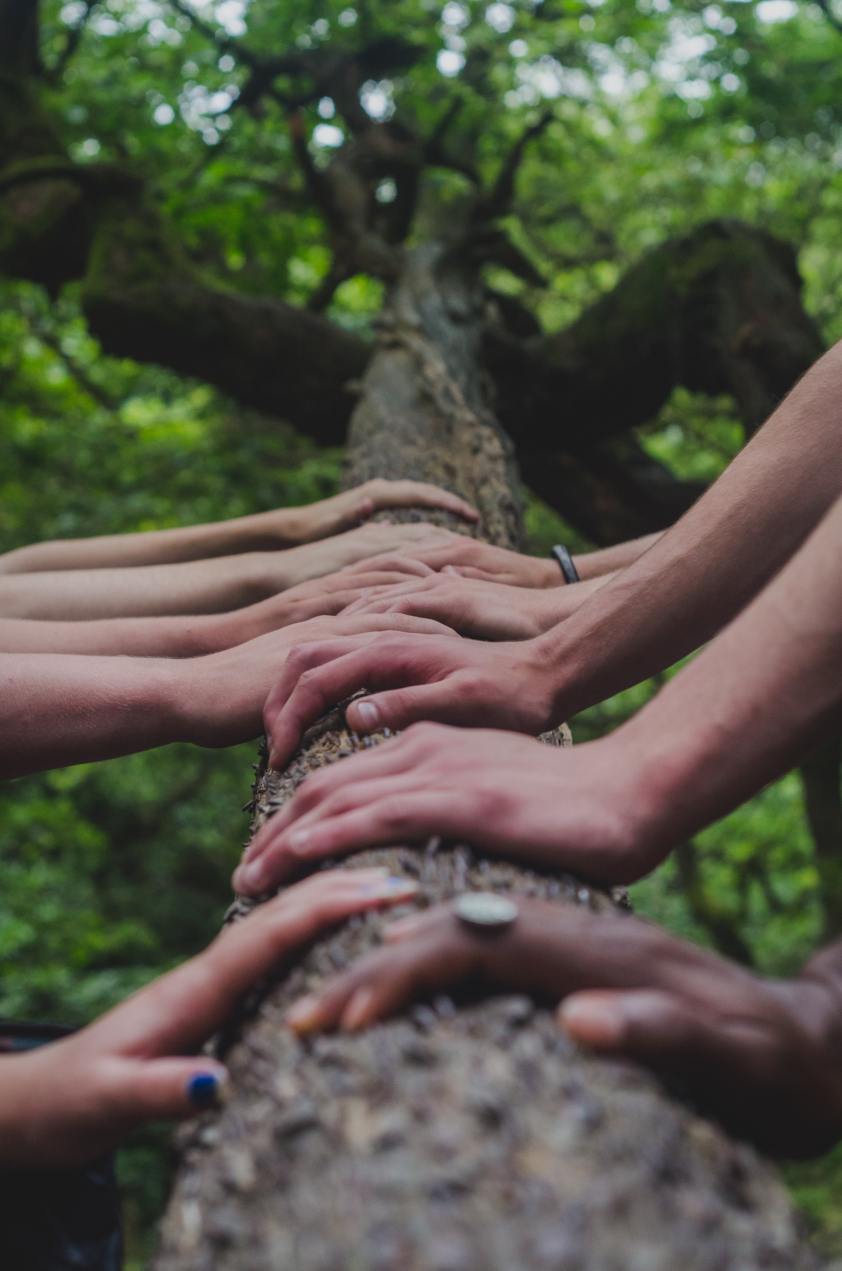
Hands of different skin tones resting on a tree trunk.

The How Part 2: When Your Community is Due for an Upgrade

After you’ve weighed the pros and cons and made the vital decision about whether to find an activism-based community, enhance an existing community, or create a community from scratch, it’s time to take the next steps. That’s fairly simple if you’ve found a community: contact them and go through their intake process if they have one. But if you’re enhancing a community or building one of your own, it’s a bit more complicated. Never fear! The How Part 2 is here!

This post focuses on how to enhance existing communities. Organizations vary in both their structure and member makeup, so these steps aren’t meant to be taken as a precise guide. Instead, think of them as vague directions coming from someone with a visual learning disability who still needs Google maps to go to the grocery store down the street. That’s, in fact, what they are. 

How to enhance an existing political community to include more community building

  • Approach the leadership of your organization, unless of course you are a leader in your organization and have already approached yourself. Make the argument to them that your org would benefit from some community building. Send them my blog posts. Or, better yet, point our specific instances within your particular organization which would have had better consequences if folks were closer to one another. Data is useful. Stories are more effective. 
  • Plan social events with some sort of structure. Although unstructured events can be fun and build relationships, there’s a strong risk that the discussions will turn political if there is no clear alternative. So, run a game of Among Us or Blood on the ClockTower or a group workout. That way, community members will have to discuss something other than the upcoming protest or last night’s newstory.
  • Once COVID is over, provide drinks, alcoholic or caffeinated. People like to have something to sip during awkward silences. 
  • Encourage others to plan their own social events. People are invested in the things they create. Hopefully, this creates a positive feedback loop leading to more and more events. 

How to enhance an existing community to participate in more activism

  • Have an honest conversation with yourself before you act. How unified are your community’s political values? To be clear, they don’t have to be perfectly aligned. You might believe that the downfall of capitalism is necessary to curb the climate crisis whereas another member of your community believes that government restrictions will suffice. Both of you would be comfortable attending a climate change protest. However, if your community is extremely politically diverse, incorporating political activism may not be the best move. Instead, you could focus on charity work like raising money for Child’s Play
  • Pull out the tea and finger pb&j sandwiches (I hate all other sandwiches) and host a book club that reads books about political issues. Activism begins with education. And if the members of your org aren’t a particularly politically charged bunch, start simple. No communist manifesto necessary. If You Come Softly by Jacqueline Woodson is a YA book that is political and also leads to everyone balling their eyes out. I highly recommend it. 
  • Invite your fellow members to volunteer for a political organization. This is logistically easier than attempting to organize your own event and shows the members of your organization what activism looks like and how rewarding it is. 
  • Remember that protesting isn’t the only option. Protestors need to be fed. Voters need to be called. Activist organizations need fundraisers. Choose activities that fit your organization’s needs and capabilities. 
  • Don’t make it miserable or overly time-consuming. One or two events a month is enough. If people aren’t invested and the work is too difficult, they’ll stop. Be more patient than persistent. 

None of this is easy. Humans are strange and unpredictable creatures. Unforeseen problems arise. Go slowly. Breathe frequently. Incremental progress is still progress.

Next week, I will discuss the preliminary steps involved in starting your own activism-based organization and embrace the opportunity to brag about my accomplishments.

The How Part 1: Your First Big Decision

Assuming that my last blog post convinced you that activism-based communities are necessary for activists’ survival, you’re probably thinking, “Oh $#!+, I don’t have one of those.” Deciding how you want to gain community is the first step to solving your conundrum. Luckily you have three options. I will list them all in order of ascending difficulty and describe the pros and cons of each of them. Read on comrades!

Option One: Find a Community

The Pros

  • This one is listed first for a reason. Once you’ve found a community, the rest is pretty easy. You will have to put effort into becoming an active member and time into building relationships and learning the norms of the group. But the logistics should be done for you.
  • A bonus perk is that you’ll learn community-building skills from the leaders of the group. The best way to understand communities to join one.

The Cons:

  • Thriving activism-based communities are hard to find, and finding one that fits your needs may be next to impossible. There are options. In big cities like Boston, cooperatives are popular (but that involves moving), the Sunrise Movement has hubs around the country (but that’s geared towards young folks), and there’s always From the Ground Up (but that’s just me humblebragging). But none of these may be what you are looking for. That’s the issue.

Option Two: Enhance an Existing Organization

The Pros:

  • If you’re already a member of a thriving activist organization that doesn’t have a community element or a community that should really be doing more political work, now is a great time to improve your organization! With already established relationships and structures, this is far easier than trying to create a brand new community. In fact, in the weeks after the 2020 BLM protests, a member of my Harry Potter and the Sacred Text group organized meetups for non-Black members to educate ourselves so that we could practice better allyship.

The Cons:

  • Easier does not mean easy. You’ll have to change or add to the existing structures within your organization. This could mean holding additional meetings, reevaluating leadership hierarchies, and/or disrupting routines. While some members of your organization may be all for it, others may be resistant.
  • Activism organizations that have never built community or community organizations that haven’t participated in activism may have a lot to learn. Communities that aren’t explicitly political will need to adapt to having political conversations. Activist organizations that don’t build community will have to learn to have conversations outside of politics. Don’t be surprised if these changes don’t happen overnight.

Option 3: Build Your Own Community

The Pros:

  • We need more activism-based communities. Period. More and more people are turning to their jobs to build community out of desperation. And, despite recent election wins, we still need political action. By building an activism-based community, you will be part of the solution.
  • You’ll gain all of the leadership skills you’ll ever need.
  • You can start by inviting the friends and comrades you already have. It’s a great way to enhance existing relationships. 
  • It will be the most rewarding experience of your life. From the Ground Up has changed everything for me. Everything.

The Cons:

  • It will also be the most difficult experience of your life. It’s a lot of work. It requires social skills, logistical skills, and balancing idealism with practicality. It’s a 24/7 job. 
  • You might fail.

That may seem like the worst possible note to end on, but failure is part of the process. And I don’t mean that in the Edison-failed-10,000-times-before-creating-the-lightbulb way. (In fact, he probably tried closer to 3,000 times, but no one really knows.) I mean that the very act of trying is an act of political resistance. Even if you don’t find a community to join, or the community you work to enhance resists, or the community you build falls apart, trying involves imagining that community is possible and worth fighting for. As adrienne maree brown put it, in her book Pleasure Activism: The Politics of Feeling Good

“I believe that all organizing is science fiction—that we are shaping the future we long for and have not yet experienced. I believe that we are in an imagination battle, and almost everything about how we orient toward our bodies is shaped by fearful imaginations. Imaginations that fear Blackness, brownness, fatness, queerness, disability, difference. Our radical imagination is a tool for decolonization, for reclaiming our right to shape our lived reality.”

adrienne maree brown

Imagine a community that reimagines the world. It’s the first step towards liberation. 

Why I Build Community Part 1

If you haven’t read my last post, check it out! It provides crucial context for this one.

Here is everything the church did for my parents (besides supposedly handing them their ticket to heaven):

  • free/affordable childcare twice a week after school, plus several weekends per year
  • free/affordable food, one meal per week for them, three for me
  • professional emotional support during hospitalizations 
  • younger parents they mentored
  • older parents who mentored them
  • recognition of my father’s military service and support throughout his deployments
  • weekly social gatherings
  • access to a small library of religious texts
  • free musical education

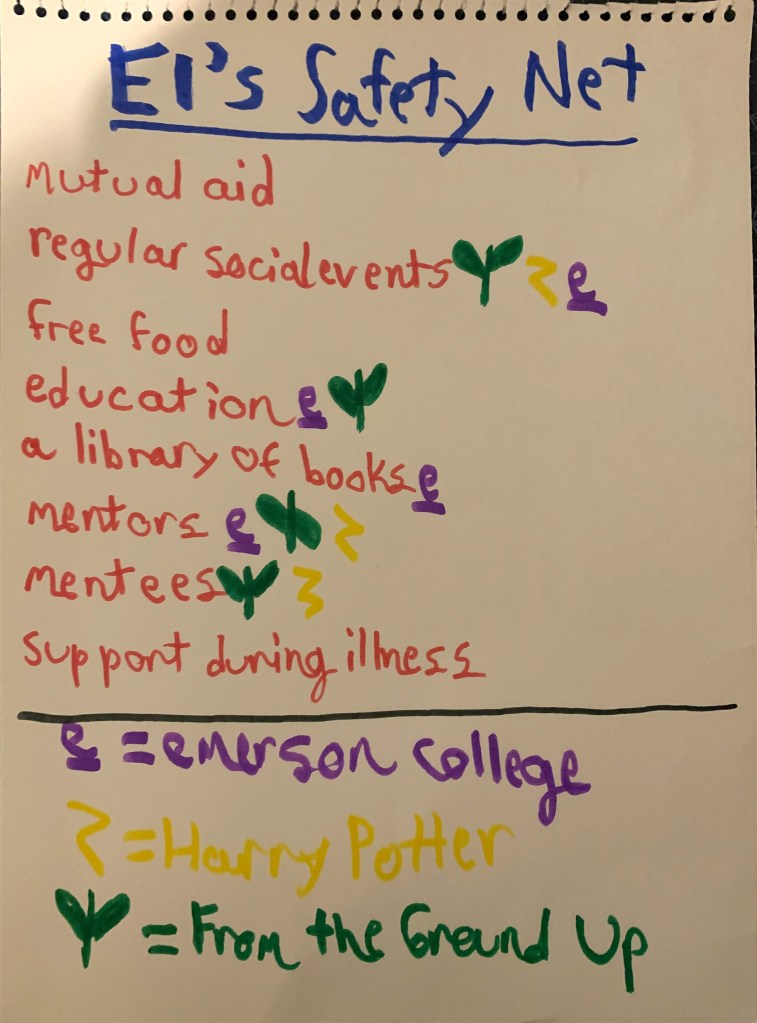
Below is a small chart of how the three organizations I’m actively a member of at the moment (sled hockey doesn’t count because pandemic) do/don’t fulfill these needs for me:

A diagram of El's needs which reveals that From the Ground Up, Emerson College, and Harry Potter and the Sacred Text only fulfill five out of the seven needs they could.
Yes, I know the key is as large as the diagram. My fine motor skills are as wonderfully disabled as I am.

Religion’s success is no accident. Any organized community that provides this range of services to its members will likely succeed. Christianity provided my parents with a built-in safety net. Despite the fact that our congregation had well under five-hundred members, it served as a source of a financial, emotional, and logistical back-up. 

Christianity, and other religions, filled this role for centuries. As Casper ter Kuile, a co-founder of the Sacred Design Lab and the Harry Potter and the Sacred Text podcast, put it in an interview

“So, in 1920, or 1880, or however far you want to go, you would have been, let’s say, a member of a Catholic Church, and you would have not only received your moral guidance and social connection but also a place for your kids to be educated. You would have had a shared ethnic group because you were part of the Italian Catholic Church. You would have had access to health care and education and mutual aid societies.”

But for most of us, it’s not surprising that Pew Research indicates that the number of people participating in religious life is dropping. (If you’re under the age of 45, how many of your friends go to church every week?) Ter Kuile believes that millennials replace church with a thousand different organized communities from CrossFit to fandoms. Yet, these communities lack the intergenerational and safety-net benefits provided by organized religion and are fundamentally built around capitalism. We have a country that’s becoming less religious during a time where the financial and social structures organized faith provides are vital. 

Americans, as a whole, have struggled to fulfill our social needs for the past decade. Even before the pandemic, studies indicated that loneliness was on the rise. According to an NPR article, a study conducted by Cigna indicated that Americans’ loneliness rose 13% between 2018 and early 2020. COVID exacerbates this problem. The Harvard Gazette cited a study showing an 11% increase in loneliness since the beginning of the pandemic, with levels as high as 61% in adults between 18 and 25 years old. This is a mental health crisis. Not only do we know that loneliness has physical health effects, but America is running headfirst into a mental health crisis. 53% of American adults report increased mental health distress according to a report by CBS. 

Of course, I don’t believe that replacing every Walmart with a cathedral would solve anything. (Although, I wouldn’t be opposed to Targets taking their place.) I don’t believe that god provided the free childcare my parents needed. People did. Lots of loving, kind, if not ableist, people. And the world has the same number of amazing people that it did a decade ago.

We need community right now. The U.S. government needs to serve the national community that it’s supposed to protect. We need to draw upon mutual aid funds. We need to check-up on the mental health of our friends, neighbors, and family members. But these are merely short-term solutions. In the long run, we need to build more inclusive organized communities that serve us all. Best of all, these communities can be designed to do activism work that serves the most vulnerable. But you’ll have to wait until my next post to read about that.