If you haven’t read my last post, check it out! It provides crucial context for this one.
Here is everything the church did for my parents (besides supposedly handing them their ticket to heaven):
- free/affordable childcare twice a week after school, plus several weekends per year
- free/affordable food, one meal per week for them, three for me
- professional emotional support during hospitalizations
- younger parents they mentored
- older parents who mentored them
- recognition of my father’s military service and support throughout his deployments
- weekly social gatherings
- access to a small library of religious texts
- free musical education
Below is a small chart of how the three organizations I’m actively a member of at the moment (sled hockey doesn’t count because pandemic) do/don’t fulfill these needs for me:
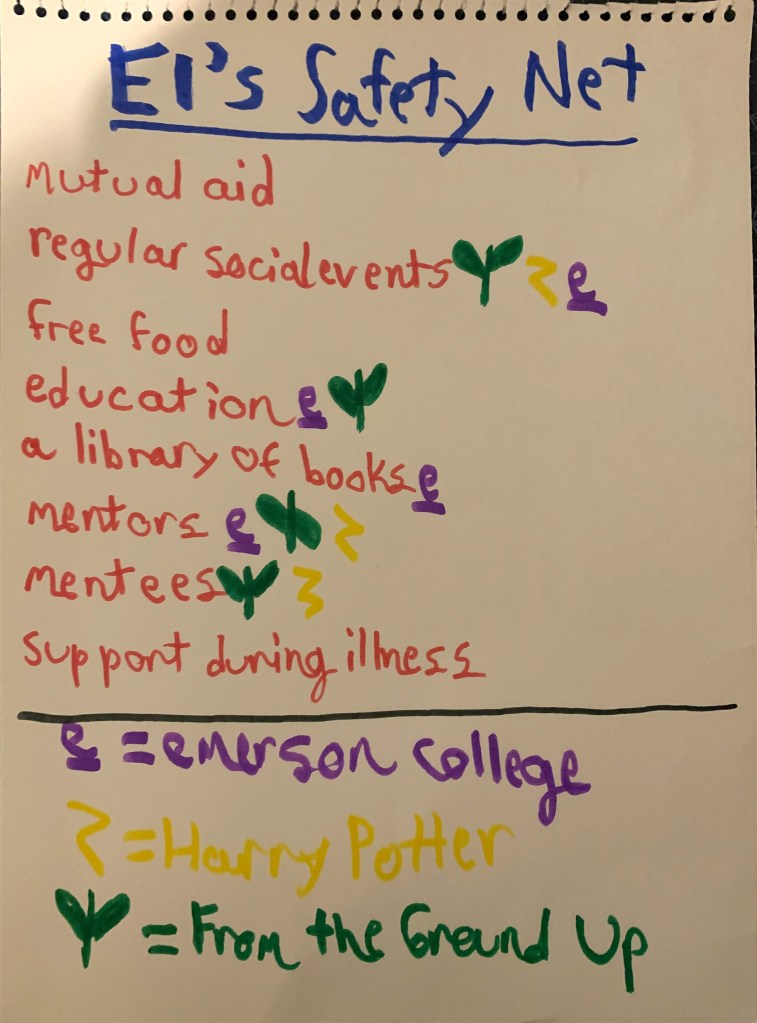
Religion’s success is no accident. Any organized community that provides this range of services to its members will likely succeed. Christianity provided my parents with a built-in safety net. Despite the fact that our congregation had well under five-hundred members, it served as a source of a financial, emotional, and logistical back-up.
Christianity, and other religions, filled this role for centuries. As Casper ter Kuile, a co-founder of the Sacred Design Lab and the Harry Potter and the Sacred Text podcast, put it in an interview,
“So, in 1920, or 1880, or however far you want to go, you would have been, let’s say, a member of a Catholic Church, and you would have not only received your moral guidance and social connection but also a place for your kids to be educated. You would have had a shared ethnic group because you were part of the Italian Catholic Church. You would have had access to health care and education and mutual aid societies.”
But for most of us, it’s not surprising that Pew Research indicates that the number of people participating in religious life is dropping. (If you’re under the age of 45, how many of your friends go to church every week?) Ter Kuile believes that millennials replace church with a thousand different organized communities from CrossFit to fandoms. Yet, these communities lack the intergenerational and safety-net benefits provided by organized religion and are fundamentally built around capitalism. We have a country that’s becoming less religious during a time where the financial and social structures organized faith provides are vital.
Americans, as a whole, have struggled to fulfill our social needs for the past decade. Even before the pandemic, studies indicated that loneliness was on the rise. According to an NPR article, a study conducted by Cigna indicated that Americans’ loneliness rose 13% between 2018 and early 2020. COVID exacerbates this problem. The Harvard Gazette cited a study showing an 11% increase in loneliness since the beginning of the pandemic, with levels as high as 61% in adults between 18 and 25 years old. This is a mental health crisis. Not only do we know that loneliness has physical health effects, but America is running headfirst into a mental health crisis. 53% of American adults report increased mental health distress according to a report by CBS.
Of course, I don’t believe that replacing every Walmart with a cathedral would solve anything. (Although, I wouldn’t be opposed to Targets taking their place.) I don’t believe that god provided the free childcare my parents needed. People did. Lots of loving, kind, if not ableist, people. And the world has the same number of amazing people that it did a decade ago.
We need community right now. The U.S. government needs to serve the national community that it’s supposed to protect. We need to draw upon mutual aid funds. We need to check-up on the mental health of our friends, neighbors, and family members. But these are merely short-term solutions. In the long run, we need to build more inclusive organized communities that serve us all. Best of all, these communities can be designed to do activism work that serves the most vulnerable. But you’ll have to wait until my next post to read about that.
 elwilson