Assuming that my last blog post convinced you that activism-based communities are necessary for activists’ survival, you’re probably thinking, “Oh $#!+, I don’t have one of those.” Deciding how you want to gain community is the first step to solving your conundrum. Luckily you have three options. I will list them all in order of ascending difficulty and describe the pros and cons of each of them. Read on comrades!
Option One: Find a Community
The Pros
- This one is listed first for a reason. Once you’ve found a community, the rest is pretty easy. You will have to put effort into becoming an active member and time into building relationships and learning the norms of the group. But the logistics should be done for you.
- A bonus perk is that you’ll learn community-building skills from the leaders of the group. The best way to understand communities to join one.
The Cons:
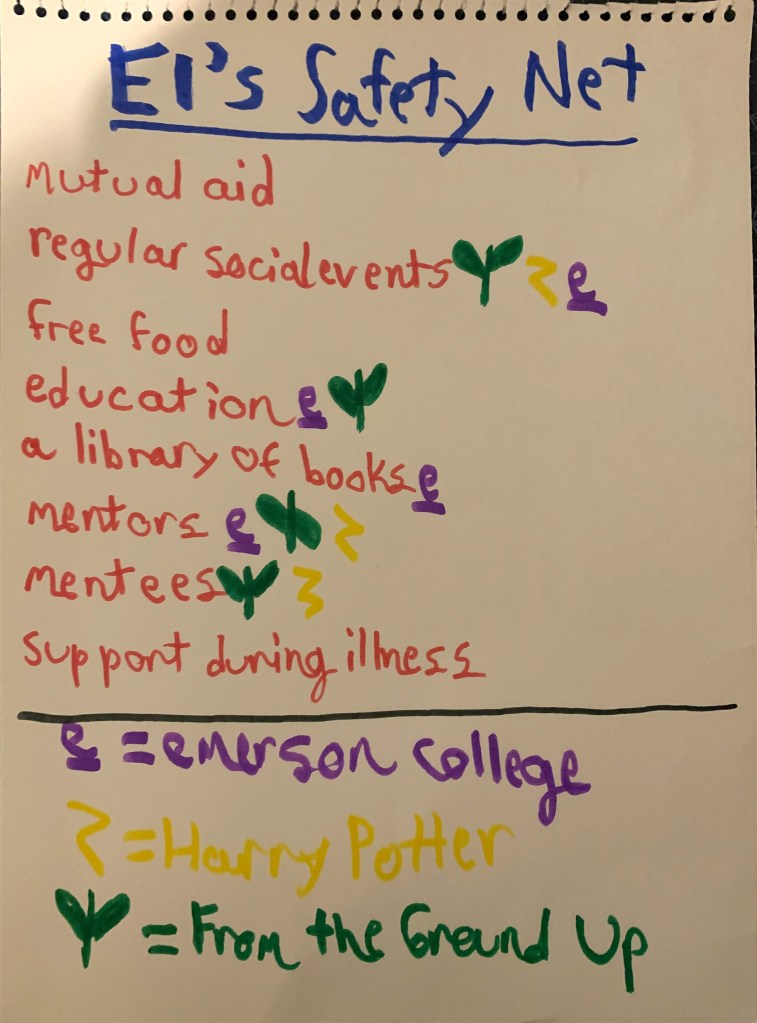
- Thriving activism-based communities are hard to find, and finding one that fits your needs may be next to impossible. There are options. In big cities like Boston, cooperatives are popular (but that involves moving), the Sunrise Movement has hubs around the country (but that’s geared towards young folks), and there’s always From the Ground Up (but that’s just me humblebragging). But none of these may be what you are looking for. That’s the issue.
Option Two: Enhance an Existing Organization
The Pros:
- If you’re already a member of a thriving activist organization that doesn’t have a community element or a community that should really be doing more political work, now is a great time to improve your organization! With already established relationships and structures, this is far easier than trying to create a brand new community. In fact, in the weeks after the 2020 BLM protests, a member of my Harry Potter and the Sacred Text group organized meetups for non-Black members to educate ourselves so that we could practice better allyship.
The Cons:
- Easier does not mean easy. You’ll have to change or add to the existing structures within your organization. This could mean holding additional meetings, reevaluating leadership hierarchies, and/or disrupting routines. While some members of your organization may be all for it, others may be resistant.
- Activism organizations that have never built community or community organizations that haven’t participated in activism may have a lot to learn. Communities that aren’t explicitly political will need to adapt to having political conversations. Activist organizations that don’t build community will have to learn to have conversations outside of politics. Don’t be surprised if these changes don’t happen overnight.
Option 3: Build Your Own Community
The Pros:
- We need more activism-based communities. Period. More and more people are turning to their jobs to build community out of desperation. And, despite recent election wins, we still need political action. By building an activism-based community, you will be part of the solution.
- You’ll gain all of the leadership skills you’ll ever need.
- You can start by inviting the friends and comrades you already have. It’s a great way to enhance existing relationships.
- It will be the most rewarding experience of your life. From the Ground Up has changed everything for me. Everything.
The Cons:
- It will also be the most difficult experience of your life. It’s a lot of work. It requires social skills, logistical skills, and balancing idealism with practicality. It’s a 24/7 job.
- You might fail.
That may seem like the worst possible note to end on, but failure is part of the process. And I don’t mean that in the Edison-failed-10,000-times-before-creating-the-lightbulb way. (In fact, he probably tried closer to 3,000 times, but no one really knows.) I mean that the very act of trying is an act of political resistance. Even if you don’t find a community to join, or the community you work to enhance resists, or the community you build falls apart, trying involves imagining that community is possible and worth fighting for. As adrienne maree brown put it, in her book Pleasure Activism: The Politics of Feeling Good,
“I believe that all organizing is science fiction—that we are shaping the future we long for and have not yet experienced. I believe that we are in an imagination battle, and almost everything about how we orient toward our bodies is shaped by fearful imaginations. Imaginations that fear Blackness, brownness, fatness, queerness, disability, difference. Our radical imagination is a tool for decolonization, for reclaiming our right to shape our lived reality.”
adrienne maree brown
Imagine a community that reimagines the world. It’s the first step towards liberation.
 elwilson